October 28, 2026
Black walnut ring: the warm tone that needs no inlay
The black walnut ring: warm tone, even grain, and the plain-wood option that looks good without inlay. Made to order in Mérida.
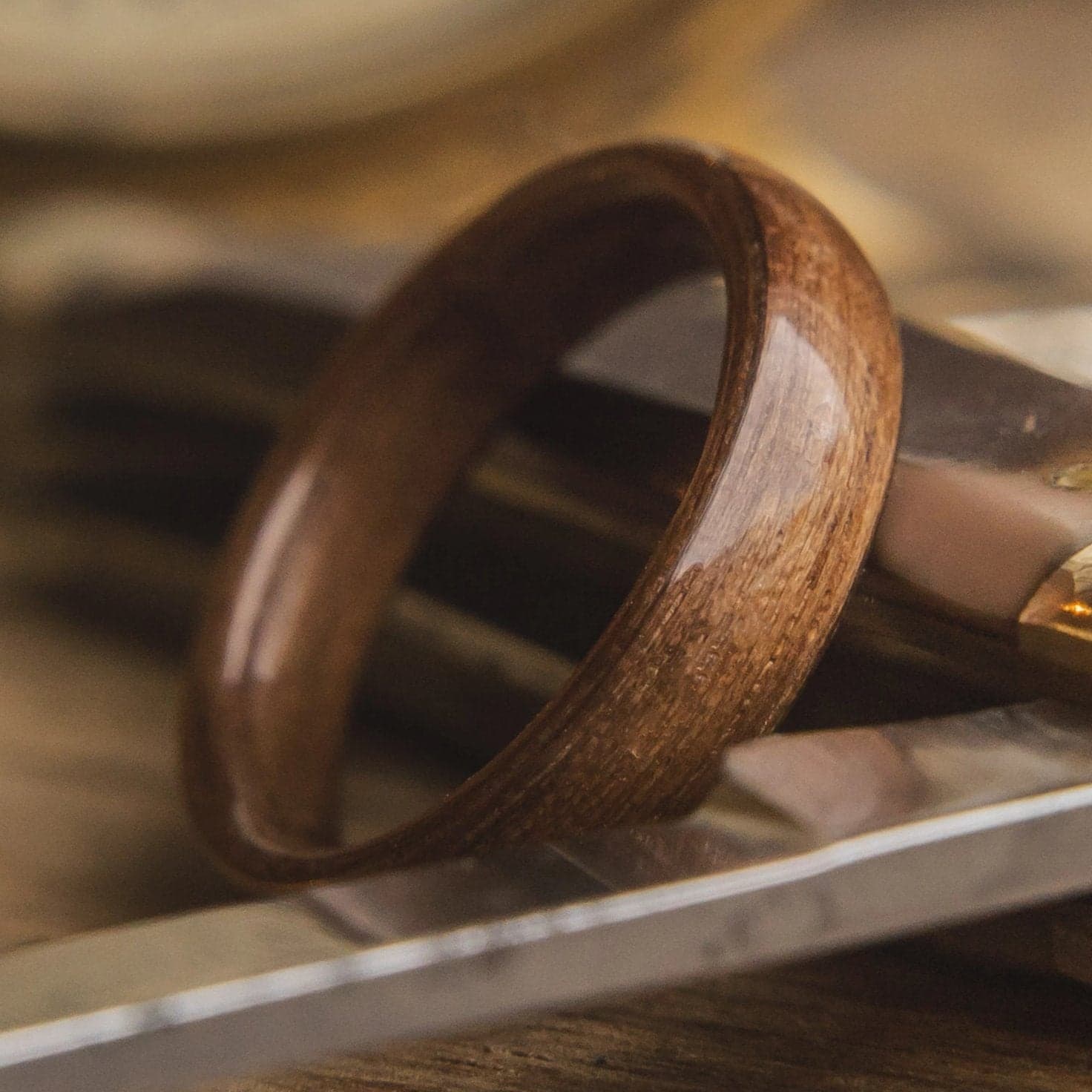
Black walnut in the ring
Black walnut is one of the most familiar woods in Mexican carpentry. It is not exotic or rare: it is the wood the carpenter knows well. In the ring, it gives a warm mid tone, between brown and reddish, with an even grain that does not compete with itself.
Why it works without inlay
Most of the catalogue's woods need inlay to look complete: ebony asks for glass or copper, maple asks for something to lift it out of neutral. Black walnut does not. Its tone is warm enough to hold up as a plain wood ring without looking empty.
In 6 to 8 mm profiles, the grain reads well without more. In slim profiles (4 mm), the tone takes over and the grain falls to the background.
In the catalogue
There is one black walnut piece in the catalogue. It is a plain wood ring, without inlay. The warm tone and even grain make it an option for those who want wood and nothing else.
Who it suits
The black walnut ring is for the person coming from a hard wood ring (oak, beech) who wants something warm but without exaggeration. It is the transition tone: not as dark as ebony, not as light as maple. Those looking for a plain wood ring without inlays find their wood here.
Care and ordering
The clearcoat is the workshop's same daily-wear clearcoat: it handles hands, shower, and pool. Black walnut does not need anything special. To order it, write on WhatsApp or email with the combination, the width, and the size. The workshop confirms the quote and the lead time. Price on request.
Questions in this guide
Yes. Black walnut is one of the most known working woods in Mexican carpentry. It is dense, works well, and gives a warm tone that people like.
Yes. There is one black walnut piece in the plain wood collection. It is a ring without inlay: just the wood, the clearcoat, and the profile.
It can darken slightly with light and the clearcoat. The daily-wear clearcoat protects the surface; if the tone changes, it is a clearcoat touch-up, not damage to the wood.